
Hamlet, Prince of Denmark shows Shakespeare's masterwork isn't just about the soliloquies
Get the best of Vancouver in your inbox, every Tuesday and Thursday. Sign up for our free newsletter.
The true testament to the power of William Shakespeare isn’t just that his works remain revered and relevant 400 years after his death, but that they have come to straddle so many disciplines. Whether your main passion is theatre, film, opera, dance, or even podcasts, you’ve got a place to dive into the world of the greatest playwright and poet the world has ever known.
Canadian dance icon Guillaume Côté—who brings the movement-based Hamlet, Prince of Denmark to Vancouver this month—remembers his first exposure to Shakespeare in high school. Growing up in a decidedly French-speaking part of rural Quebec, he went to the National Ballet School at age 11, where he discovered that he was going to need to learn English. Shakespeare was there to help.
“I think it was in Grade 8 where we started A Midsummer Night’s Dream,” he recalls in an interview with the Straight. “Then we worked our way through Macbeth, and I think that Hamlet was in Grade 12. It was difficult. But at the same time I was really fascinated by the poetry within the plays. So learning English and learning Shakespeare was quite magical—it felt like there was much there because it was so rich.”
Important as those first experiences were, Côté’s game-changing encounter with the works of Shakespeare didn’t come from reading them.
“My most direct relationship to Shakespeare came through the ballet Romeo and Juliet,” he shares. “After Grade 12 I really dove into my dance career. In dance, one of the most explored of Shakespeare’s stories is Romeo and Juliet. And I got to dance it right off the get-go. I don’t why—I guess I was kind of typecast for having good hair, so I got to do it really early on. And that was an interesting thing because it forced me to really explore the play.”
 Bruce Zinger.
 For Hamlet, Prince of Denmark, which he also dances in, Côté collaborated with Canadian visionary Robert Lepage of Quebec’s celebrated multidisciplinary company Ex Machina. Côté had seen a past one-man telling of Hamlet by Lepage and had his mind blown, with that sparking a friendship that led to them later becoming collaborators.
Laughing, Côté says, “I sort of mentioned, not casually, but forcefully, ‘I want to do a Hamlet, and I’d like to do it with you. Because if anyone can help me translate it into dance, and find what is relevant about it through dance, it’s you.’ It took me a while to convince him to dive into the proposition. He was trying to find his point of entry—the how and why and those kinds of questions.”
That was also a challenge for Côté. And so he drew on his own past as an artist. At the age of 30, the dancer again found himself cast as Romeo in a new National Ballet production helmed by Alexei Ratmansky. He remembers pushing himself to dive into the play deeper than he ever had, thinking about different interpretations, exploring the layers of the different characters, and dissecting their motivations.
“Finding these little key moments that Alexei wanted to express through dance was a life-changing experience for me,” he remembers. “That’s where I knew that I wanted to do something eventually to Shakespeare in that same way.”
When Côté and Lepage set out to capture Hamlet through dance, the process started with intensive workshopping. Côté suggested going an abstract route, where movement was reflecting the psychological aspects of ghosts of the past. Lepage pushed for a more tradition-based approach, albeit with abstract flourishes.
“Very early on, Robert was like, ‘No. The only way to do this is by going through Hamlet scene by scene, and doing a proposition where we tell the story exactly as it is, but without the text.’ ”
Telling the story of the Prince of Denmark through dance proved less daunting than one might have expected. While famous for its soliloquies and words, Côté argues that Hamlet is also an impeccably structured action play that moves from scene to scene quickly. He adds that many scholars have suggested the play’s extended soliloquies were written to give stagehands at the historical Globe Theatre time to move set pieces into place.
Lepage has a reputation for visually stunning multimedia works, as evidenced by past creations like The Far Side of the Moon and an opera version of The Tempest with Vancouver dance legend Crystal Pite.
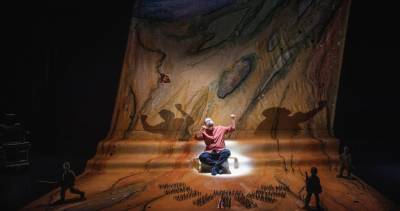
Hamlet, Prince of Denmark takes more of a streamlined approach, both time-wise (an hour and 40 minutes, compared to Shakespeare’s OG five-hour version) and in its staging. Tables double as coffins, mirrors are moved to create hallways, and the ghost of Hamlet’s father is a bedsheet. If that sounds DIY, it shouldn’t, as reviews have raved about the visual innovativeness of the production—not to mention the new way of telling of a centuries-old story that continues to find audiences.
“It has a lot in it,” Côté promises of the show. “Robert is known for multimedia spectacles, but part of it here was budget. It was us sitting down and going, ‘We don’t have money for much, so what can we afford? We can afford curtains, sheets and swords and tables. And people to choreograph.’ Still, there are moments in the show that are pretty amazing—dancers behind a sheet lifting and drowning Ophelia in a really spectacular way.
“It’s great to see that it doesn’t take much sometimes—just patience and creativity.”
DanceHouse, Ex Machina, and Côté Danse present Hamlet, Prince of Denmark at Vancouver Playhouse on March 18-21.
 Roman Boldyrev












Comments