
Jillian Harris wants you to shop with your values
Get the best of Vancouver in your inbox, every Tuesday and Thursday. Sign up for our free newsletter.
Long before The Jilly Box existed, Jillian Harris was a familiar face on television screens.
She first entered the public consciousness through The Bachelor and The Bachelorette, later becoming a designer and co-host on Love It or List It Vancouver. There were other appearances—Extreme Makeover: Home Edition, Canada’s Handyman Challenge, The Bachelorette Canada. For years, her career was defined by formats built by other people: other producers, other networks, other storylines.
What she didn’t have, she says, was her own platform.
“I always felt like I never really had the foundation to tell my own story,” Harris reflects.
Social media changed that. What began as behind-the-scenes glimpses into her life gradually became something more intentional: a community. Not followers, not fans—community. That distinction would later become the backbone of her business.
By the late 2010s, Harris was deep into the influencer economy. Brand partnerships were thriving. Boxes of gifted product arrived daily. At first, it felt like a dream. Then it started to feel excessive.
The turning point wasn’t about volume—it was about impact. When she shared products from global luxury brands, nothing moved emotionally. But when she spotlighted a small Canadian founder, a scrunchie maker named Chelsea King, the response was immediate and personal.
“She would be in tears,” Harris recalls. “It made such a difference to her family.”
That feedback loop shifted her lens. What if influence could be the infrastructure for something bigger?
With longtime agent and now co-founder Tyler Evans (who has worked with Harris for 17 years) the idea of scaling those small-business collaborations began to take shape. Over meetings at Vancouver’s Pacific Rim and around Harris’s kitchen table, they moved from one-off launches to a bigger concept: a subscription box that could amplify multiple independent brands at once.
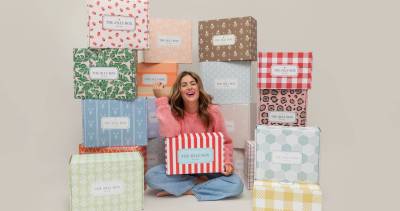
They launched The Jilly Box in 2019 with 5,000 units. Within 24 hours, more than 100,000 people joined the waitlist.

Six years later, the company ships roughly 20,000 boxes per quarter and has expanded into a year-round online marketplace. More than 250 brands have been featured, many women-owned, Canadian-owned, or impact-driven. The company employs 22 people and has donated over $1 million back into communities.
But the real story isn’t scale. It’s restraint.
In an era when creator-led brands often pivot quickly to private label—cutting out suppliers to maximize margin—The Jilly Box has chosen not to. Evans acknowledges the temptation. Introducing in-house products would likely increase profitability. With Harris’s reach, they would almost certainly sell.
Instead, the company continues to prioritize spotlighting external founders. That decision comes at a cost.
The business pays fair market rates to vendors. It offers living wages, RRSP matching, baby bonuses, and extended benefits to employees. Internally, profitability is only one metric. Harris describes “modifiers” that matter more: employee happiness, B Corp certification, community impact. In many traditional businesses, those are secondary considerations. Here, they are structural.
“Profitability might never grow,” Harris says. “And that’s okay.”
It’s a philosophy that runs counter to modern growth culture, and one that has been stress-tested.
Subscription commerce leaves no room for delay. Customers have already paid. Products are sourced from multiple vendors, often in 20,000-unit volumes. Ethical manufacturing, quality control, and timing must align perfectly.
“We’re still learning,” Evans says. “There’s no handbook for this.”
Another ongoing challenge: founder dependency.
Despite the growing team, customers still want to hear directly from Harris when something goes wrong. Attempts to formalize communications through marketing statements have felt distant. Trust, it turns out, is personal, and built over decades of visibility.
That creates a strategic tension. Can the business mature beyond its founder without losing the community attachment that powers it?
Harris admits she sometimes fantasizes about untethering her name from the brand. But she also recognizes that her voice is still its gravitational centre.
Now, with the expansion of The Market, a curated online storefront that allows customers to shop by values—the company is entering a new phase. For years, traditional media felt unnecessary; the boxes sold out without it. The marketplace, however, is built for ongoing growth.
Harris speaks openly about why this matters to her. She worries about the dominance of big-box retail, about AI-driven commerce, about what happens to local economies if independent businesses disappear.
“Who will donate to your daughter’s ballet?” she asks. “Who will sponsor hockey?” It’s a practical question disguised as a cultural one.
The Jilly Box is not a charity. It is a for-profit company built by someone who understands both brand and television spectacle. But it’s also a case study in what happens when a public figure chooses to use their influence for more than just endorsements.
Selling out in a day is impressive. Building a values-first retail engine, and resisting the urge to optimize purely for margin, is harder.
For Harris, who once operated within storylines written by others, this may be the most meaningful chapter yet: not reality television, but real-world commerce, with all its chaos, complexity, and consequence.
And unlike television, there’s no script.













Comments