
An acid western Christ comedy: Kier-La Janisse on Greaser's Palace and Spectacular Optical's book on Robert Downey Sr.
Get the best of Vancouver in your inbox, every Tuesday and Thursday. Sign up for our free newsletter.
We must presume that there are readers who know the actor Robert Downey Jr. but who are unaware of the work of his father. Robert Downey Sr. was a filmmaker in his own right, active between 1953 and 2005, whose most widely-seen film is probably Putney Swope.
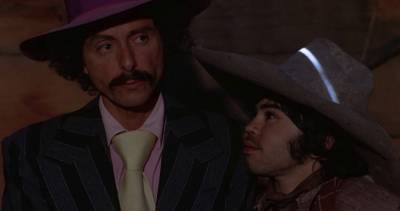
He's basically an extra—a small boy who gets resurrected by a Christ figure named Jesse. If all you really care about is seeing Robert Downey Jr., the scene is (poorly) represented on YouTube here. Really, if that's the extent of your curiosity, you can go back to the MCU now.
We are hoping, however, that sharing that scene raises some questions in your mind, first and foremost being "Why the very fuck is there a crucified man wearing a zoot suit?". The short answer is that Greaser's Palace is a comic "acid western" and a product of the American counterculture, a spiritual companion to films like El Topo, The Last Movie, and Zachariah, filled with an unique and exuberant humour and entertaining song-and-dance routines, delivered by Jesse.
It is doubtlessly the second-funniest musical comedy "about" Christ (kinda) after The Life of Brian. Or maybe The Life of Brian is the second funniest musical comedy "about" Christ after Greaser's Palace? If there is a third contender, we don't know it (we don't recall many yuks in Jesus Christ Superstar).
Jesse is played in the film by Allan Arbus (whose having been married to the woman who shot the photograph that SNFU stole for their first LP is also not a good reason to see this film, but it's worth mentioning, I suppose). Though also known as a photographer, Arbus had a long acting career, appearing in everything from 1973 blaxploitation hit Coffy to episodes of M*A*S*H to Law and Order (and even an episode of Curb Your Enthusiasm).
You can see one of his song-and-dance numbers on YouTube, with the scene feeling so much like an outtake from Alex Cox's anarchic spaghetti western homage Straight to Hell that you half expect Karl the Wiener Man to show up and start selling hot dogs.
We are approaching a good reason to not miss the Wednesday screening of Greaser's Palace at the VIFF Centre. The donkey is another: Greaser's Palace has maybe the funniest scene in cinema history involving a donkey, but that's probably a hard-sell, eh?
No, the best thing about the screening on Wednesday is that Kier-La Janisse will be on hand to introduce the movie, and will have select merch with her. The Straight reached out to Janisse to explain a bit about the film, the book, and acid westerns in general.
Films of that ilk actually do often benefit from being seen under the influence of psychedelics, but we at the Straight have not tried that with Greaser's Palace. Should the movie be seen under the influence? Should it be at least understood as a drug culture film?
"As much as we call these kinds of westerns 'acid westerns' because of their strange odyssean qualities, I don't think acid was Downey's drug," Janisse tells the Straight. "He was very much a cocaine guy and I think he's starting to get access to more of it at this point. But this is also a crazy cast of characters, and who knows what drug who is doing. This was the beginning of an intense collaboration with Jack Nitzsche and Nitzsche was more of a booze and speed guy, as far as I know. I think having a few cast members in common with Easy Rider definitely carries that association of being a drug movie too."
As for watching it stoned, she continues thus: "I couldn't say as I haven't touched drugs for 25 years, since before I first saw Greaser's Palace. But Downey is deeply silly and so I can only imagine some of the humor is transformed through the use of weed or lysergics. It's really interesting to look at it next to something like The Last Movie or Zachariah, because on the one hand these things go together, but Downey remains separate because of his love of classic comedy which comes through in the work."
The Spectacular Optical book, which Janisse contributes to and co-edited alongside Montreal artist, author, and curator Clint Enns, is a collection of essays by different scholars and critics. There is no exhaustive production history of Greaser's Palace in the book, so Janisse can't answer the questions I have about the treatment of the donkey, whose annoyance with the film's goings on is probably not acted. ("No animals were harmed in the making of this picture, but a donkey was sorely irritated.") There are no interviews with surviving cast and crew, either, though Janisse admits that during the 10 years the book was being assembled, she and Enns did try to interview Robert Downey Sr. ("He was resistant to having his career documented—and then he just got too sick.")
However, the last two chapters of the book are written by people Downey worked with: film editor Stan Warnow and cinematographer Kevin Ford, who shot a Netflix documentary about the elder Downey, called Sr. They offer some insight into how Downey worked.
Interviews and production histories weren't really what the book was about, anyway.
"What we noticed with any coverage of Downey's work," Janisse explains, "was that it really focused on the interview format and just letting him insist that his work wasn't meant to be analysed. So we decided to take the approach that no one else was taking, which was basically to try and unpack or contextualize these very funny but also sometimes 'problematic' films.
Janisse and Enns did try to get Robert Downey Jr. to write a foreward to the book.
"But he was filming in Europe and Rosemary [Downey's widow], who was our liaison, said that he was very unlikely to respond during shooting. I know he has copies of the book; Rosemary gave him one, Kevin Ford who wrote the last chapter and was a producer on the documentary Sr. sent him one, and even Don McKellar sent him a PDF of it back when we were still in production. So he has it! No idea what he thinks of it, but Rosemary did say he was happy to see that it had a chapter all about his mom."
While proud of the book, one element of its publication is a bit bittersweet for Janisse.
"The funniest (saddest?) outcome of it all is that after 10 years of trying to get the book done and facing so much resistance, Rosemary said after reading it that he would have loved the book," she says. "Especially the chapters about Chafed Elbows by Eivind Rossaak and Christine Lucy Latimer's chapter breaking down the Marx Brothers influence on his films."
Janisse will have some Spectacular Optical merch with her at the VIFF Centre. (More information on the night, this Wednesday [March 3], go here). The evening will include copies of Truth & Soul—including copies in the slipcase ("it reproduces Alvin Weasley's iconic denim Mensa jacket from Putney Swope"). There will also be copies of her previous book as author, Cockfight: A Fable of Failure, about Monte Hellman's film Cockfighter, and possibly copies of Spectacular Optical's Warped & Faded. We hope to see you there!





Comments